 Kelpdao
Kelpdao withdrawals exchange rsETH for supported assets through routes with different costs and waiting periods
Kelpdao withdrawals redeem rsETH into ETH, ETHx, or stETH on Ethereum, with instant and standard modes. Standard redemption carries no protocol withdrawal fee and has a documented waiting period of 15-21 days. Instant redemption charges a configurable fee and requires available funds for the chosen asset. A market swap sells rsETH at an executable price, with trading costs and gas affecting its proceeds. Eligible balances left on networks whose bridging ended after June 15, 2026 follow a separate recovery process. Comparing exits means matching the asset received and its chain, then considering the net amount and settlement conditions.
Updated on
In short: A post-fee rsETH withdrawal quote can meet an ETH target even when gas costs push net proceeds below it.
Which redemption route trades waiting time for a fee?
Standard redemption exchanges a documented 15-21-day wait for zero protocol withdrawal fees, while instant redemption charges for faster access to available funds. The Restaking Guide describes instant withdrawal as immediate; execution still depends on available funds. Neither duration establishes when an individual transaction will settle. Network inclusion and the selected mode’s requirements remain relevant. A market sale adds another price comparison: its executable proceeds can differ from the amount protocol redemption would return for the same rsETH balance.
Withdrawal requests and the assets they release
Standard requests and final payouts
The LRTWithdrawalManager implementation queues a standard request and requires a later completion call to transfer the chosen asset to its owner. Standard completion requires an unlocked request and an elapsed configured delay. A queued request records a pending withdrawal, not receipt of the asset.
This implementation pays the lower of the original expected asset amount and the recalculated return. Later pricing can reduce the payout, so the initial estimate is not a settled balance.
Instant funds and execution fees
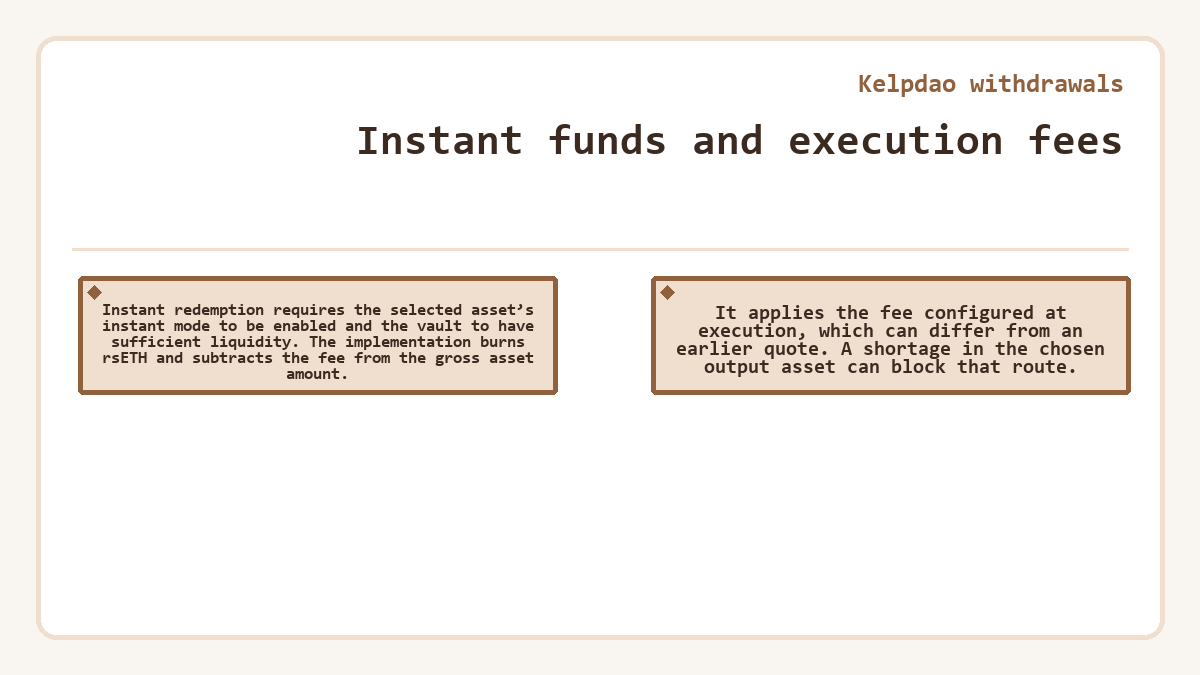
Instant redemption requires the selected asset’s instant mode to be enabled and the vault to have sufficient liquidity. The implementation burns rsETH and subtracts the fee from the gross asset amount. It applies the fee configured at execution, which can differ from an earlier quote.
A shortage in the chosen output asset can block that route.
Can a market swap provide a cheaper rsETH exit?
A market swap can cost less than instant redemption when it returns more for the same rsETH input after deducting each route’s fees and gas. Selling rsETH transfers the receipt through a trading venue; it does not redeem the underlying position through the withdrawal queue. Available pool liquidity influences price impact, while price changes before execution create slippage. The comparison needs the same output asset and destination chain. A local token sale does not itself move its proceeds to Ethereum mainnet.
Compare proceeds after fees and gas
Protocol charges and network costs
A zero protocol withdrawal fee leaves network costs payable. Ethereum charges for the computation each included transaction consumes, and the sender pays those charges in ETH. Asset amounts and gas prices use different units: a token balance is a quantity, while gwei commonly expresses the price per unit of gas. One gwei equals one-billionth of an ETH. Multiplying gas used by the effective gas price gives the transaction’s network cost. Additional required interactions add their own cost to the exit.
Compare the asset amount after route fees, then subtract aggregate network costs in a consistent unit. When an output quote already includes a fee, deducting that fee again understates the proceeds. ETH, ETHx, and stETH require different interpretations because receiving a liquid staking token leaves a liquid staking position. An ETH-denominated valuation helps compare values, but the tokens received still differ. Likewise, an rsETH protocol conversion rate and a market execution price answer different questions about the same holding.
A quoted ETH amount can miss a net target
An instant quote can exceed a target before gas and fall below it after gas. For this hypothetical calculation, set a net target of 2.733 ETH, a post-fee withdrawal quote of 2.743 ETH, and aggregate network costs of 0.013 ETH. The quoted withdrawal amount already includes the instant fee; the separate network cost represents the assumed total ETH spent on required transactions.
Subtracting 0.013 ETH from 2.743 ETH leaves 2.730 ETH, missing the target by 0.003 ETH. The quote’s apparent 0.010 ETH margin covers only part of the gas cost.
That conclusion holds only for the assumed post-fee quote and aggregate gas cost. A changed execution fee or an additional required transaction changes the calculation. Standard redemption avoids the instant charge, although its separate waiting period and network costs still apply.
What changes when rsETH sits on a retired network?
Eligible rsETH left on a retired bridge network follows recovery rules, including a separate fee and quarterly settlement, before Ethereum redemption becomes relevant.
Recovery eligibility and timing
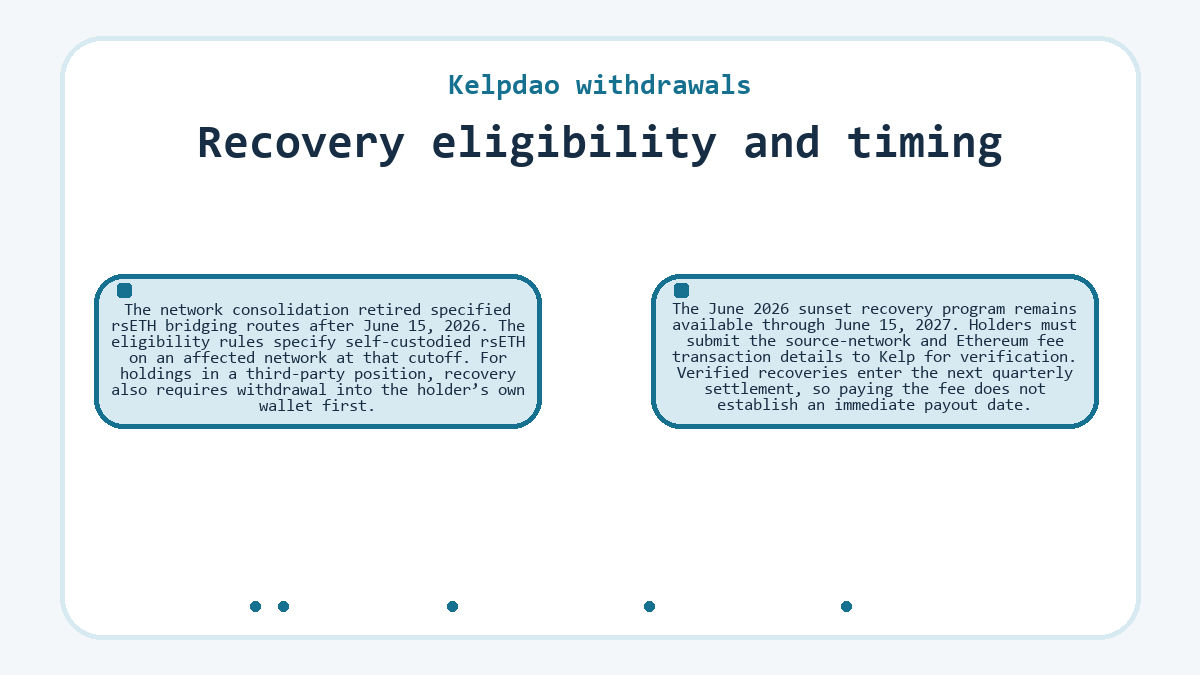
The network consolidation retired specified rsETH bridging routes after June 15, 2026. The eligibility rules specify self-custodied rsETH on an affected network at that cutoff. For holdings in a third-party position, recovery also requires withdrawal into the holder’s own wallet first. The June 2026 sunset recovery program remains available through June 15, 2027. Holders must submit the source-network and Ethereum fee transaction details to Kelp for verification. Verified recoveries enter the next quarterly settlement, so paying the fee does not establish an immediate payout date.
EVM and movement recovery
On affected EVM networks, the recovery process requires converting wrsETH to rsETH where necessary before burning rsETH. Sending wrsETH to the burn address permanently loses that wrapped token. Movement uses a separate recovery Safe and an exact-amount MOVE challenge with a 30-day expiry. Its procedure does not use the EVM burn method. These routes return equivalent rsETH on Ethereum mainnet; receiving that token does not itself redeem it into ETH.
Recovery fees and the asset returned
The recovery fee is 100 USDC per address, paid separately on Ethereum mainnet. It does not reduce the rsETH quantity returned. Source-network transactions and the Ethereum fee payment also require gas, so the flat fee alone does not describe the total cost. Recovery and an eventual rsETH sale or redemption have separate cost and timing conditions. The recovery deadline belongs to this network-retirement program, rather than establishing a deadline for ordinary Ethereum redemption.
Bridge incidents and restrictions on exit preparation
The April 2026 bridge incident affected a cross-chain verification route, creating risks distinct from ordinary Ethereum redemption. Mainnet staking backing and bridge backing serve different functions. An assessment of backing does not establish available withdrawal liquidity, and an active token balance does not establish permission to use every DeFi integration. These distinctions matter when an exit first requires removing rsETH from another contract.
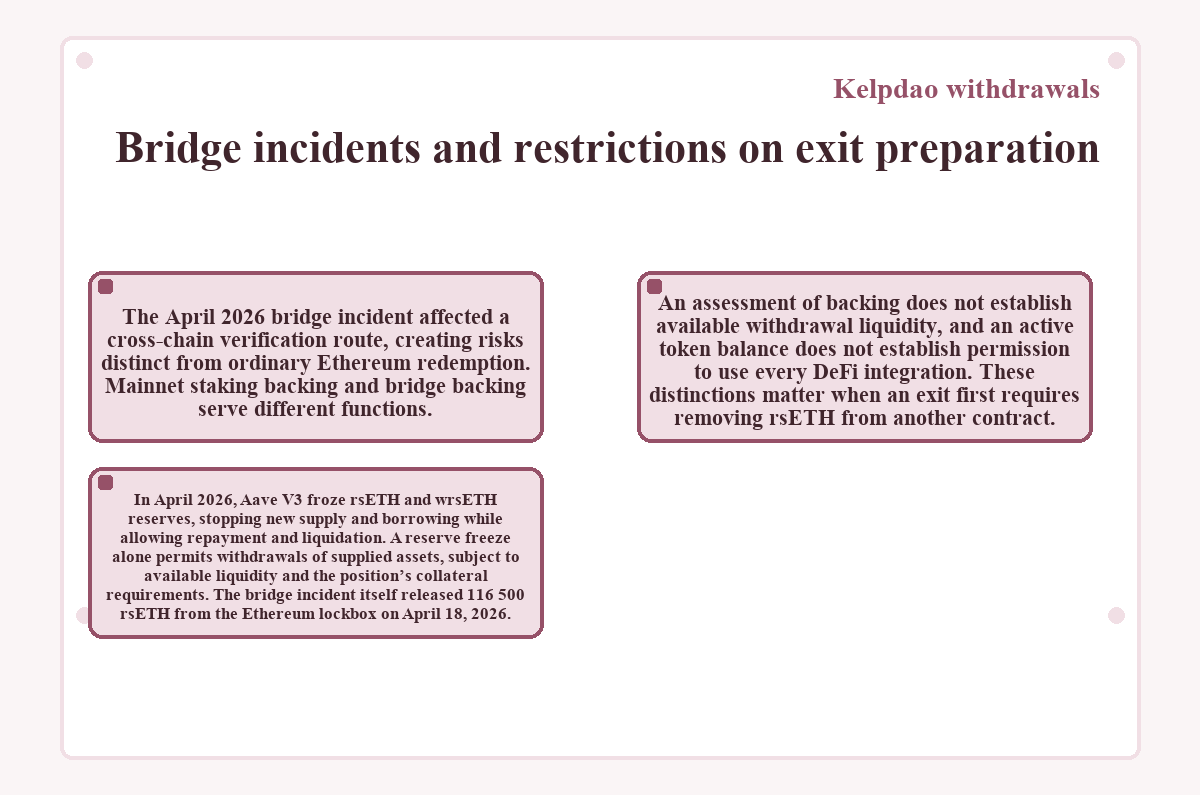
In April 2026, Aave V3 froze rsETH and wrsETH reserves, stopping new supply and borrowing while allowing repayment and liquidation. A reserve freeze alone permits withdrawals of supplied assets, subject to available liquidity and the position’s collateral requirements. The bridge incident itself released 116 500 rsETH from the Ethereum lockbox on April 18, 2026.
Kelpdao withdrawals: frequently asked questions
-
Does a reverted rsETH withdrawal still cost gas?
- A withdrawal transaction included on Ethereum consumes gas even when its contract call reverts. Reversal of the asset movement does not refund the computation already performed. The charge concerns an executed transaction; a wallet rejection before submission is a different state. Repeating a failing call can therefore add network costs without completing the withdrawal.
-
Where do unclaimed EIGEN rewards fit into an rsETH exit?
- Unclaimed EIGEN follows a separate reward allocation and claim process. The program allocates tokens from eligible weekly positions, then makes claims available through a Merkle distributor and the Claim Token section. Redeeming rsETH and receiving an EIGEN allocation measure different assets. A withdrawal quote for ETH or a liquid staking token does not represent an EIGEN payout.
-
Is a blocked rsETH address still able to redeem its visible balance?
- An active address block in the rsETH implementation can prevent transfers or burns despite a visible balance. Withdrawal contracts need to move or burn rsETH, so the affected operation can fail at the token contract. The restriction concerns the blocked address and operation; a displayed balance alone does not establish an executable redemption.
-
Can a different Ethereum address pay the sunset recovery fee?
- EVM sunset recovery requires the same wallet address for the source-chain burn and the Ethereum USDC payment. That address receives the recovered rsETH on Ethereum. Movement has a different source-address structure, but its Ethereum fee payment must come from the requested Ethereum payout address. An unrelated payer does not meet the stated address requirements for either procedure.
-
Are Kernel’s BscScan claims available for rsETH withdrawals?
- Kernel’s BscScan claims concern the separate Kernel restaking product, rather than Kelpdao rsETH redemption. Its StakeManager withdrawal functions cover that product’s supported assets. The June 2026 Kernel interface retirement explicitly excluded Kelpdao and Gain. An rsETH exit therefore follows the applicable Ethereum withdrawal, market-sale, or sunset-network recovery conditions instead of Kernel’s BNB-oriented claim functions.
-
Why can a small withdrawal fail despite an adequate rsETH balance?
- The withdrawal-manager implementation sets minimum rsETH amounts by output asset. Standard and instant withdrawals revert if the requested rsETH amount is zero or below that minimum, even when the wallet holds enough rsETH. Deposit limits and token-transfer rules govern different operations.