 Kelpdao
 connects Ethereum restaking with DeFi through rsETH
Kelpdao is an Ethereum liquid restaking protocol that issues rsETH against deposits of ETH and supported liquid staking tokens. Restaking lets staked assets support additional services, while rsETH keeps the resulting position transferable. Compatible decentralized finance (DeFi) applications provide ways to trade rsETH or use it in lending arrangements. Kelp is the product name used within the KernelDAO ecosystem. Some rsETH bridge networks retired in June 2026, creating a separate recovery path for eligible balances left on those chains.
Updated on
The short version: Liquid rsETH can circulate through DeFi, while redeeming the underlying assets follows a separate withdrawal route.
ETH deposits, node operators, and rsETH
Deposit assets supply the capital, operators participate in restaking services, and rsETH represents a share of the underlying position.
ETH and liquid staking tokens
ETH enters as Ethereum’s native asset. A liquid staking token already represents a staking position. Kelp’s documented deposit options include ETH, stETH, and ETHx. Acceptance depends on the asset and chain the deposit interface supports; a token’s presence in a wallet does not establish deposit compatibility.
Operators and EigenLayer
Kelp coordinates deposited assets through node operators participating in EigenLayer. Restaking extends the use of staked capital to additional services. The arrangement brings service and operator dependencies alongside the underlying Ethereum staking exposure. Slashing penalties can reduce the assets backing rsETH. Rewards originate from the staking and restaking services the pooled assets support.
rsETH and the underlying pool
rsETH is the liquid restaking token, or LRT, issued against the pooled assets. Underlying assets and accumulated rewards determine the value represented by rsETH. Converting its token balance into an ETH redemption amount requires the applicable exchange rate, while an exchange trade also reflects market liquidity.
How can rsETH circulate while its backing remains restaked?
rsETH circulates as a transferable claim on the restaking position, allowing compatible DeFi applications to use the token while the backing stays deployed. Trading transfers that claim to another holder, while lending or liquidity provision places it under the receiving protocol’s rules and adds that protocol’s contract and market dependencies to the existing restaking exposure.
An exchange swap and a protocol withdrawal obtain liquidity through different mechanisms. A swap relies on market liquidity and its execution price. Kelp’s withdrawal mechanism releases an underlying asset through its own process. Withdrawals into ETH, ETHx, or stETH take place on Ethereum. The Restaking Guide lists a 0.5% fee for immediate withdrawals in Instant mode. This mode requires enablement for the selected asset and sufficient liquidity in the unstaking vault. Standard mode has no withdrawal fee and an estimated wait of 15-21 days. Network transaction costs remain separate in either mode.
Preparing a deposit and reading its costs
Asset, chain, and transaction details
A deposit requires a supported input asset, the appropriate network, and funds for transaction fees. The wallet transaction identifies the asset and amount entering the protocol. Its rsETH output depends on the applicable conversion rate, so comparing the input and output requires their respective units. The portfolio can display the restaked position after confirmation. A signed wallet request alone does not establish a completed deposit.
Reward commissions and network fees
Kelp’s LRT business model includes commissions on staking and restaking rewards. Blockchain transaction fees fund execution separately from those commissions. An external DeFi integration or Gain vault can introduce its own charges, which belong to that particular use. Underlying rewards, commissions, and token valuation determine the position’s economic outcome. A displayed annual rate can change as those inputs change, and a subsequent withdrawal or market sale introduces the costs of that particular exit.
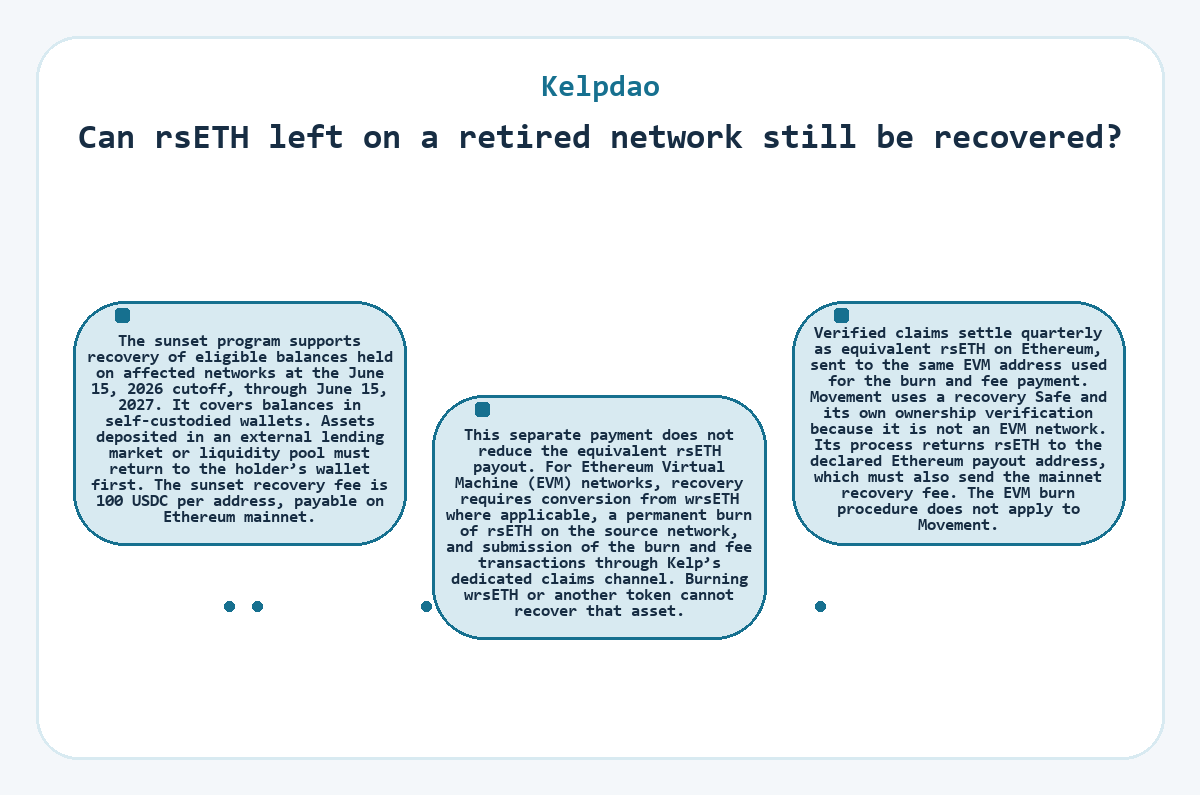
Bridge security and the 2026 network changes
On April 18, 2026, a forged cross-chain message released 116 500 rsETH from Kelp’s Ethereum bridge inventory. The affected Unichain-to-Ethereum route used LayerZero messaging with a single required verifier. Compromised verification infrastructure enabled the message’s acceptance without a corresponding source-chain burn. This was a bridge release, distinct from a deposit backed by new staking assets.
In May 2026, Kelp announced a migration of rsETH to Chainlink’s Cross-Chain Interoperability Protocol, or CCIP, and Cross-Chain Token standard. The migration concerns cross-chain transport. Ethereum staking, rsETH issuance, and the availability of a particular external lending market remain separate parts of the system.
After June 15, 2026, Kelp retired rsETH bridging on Optimism, Manta, Mode, Blast, Scroll, X Layer, ZKsync, Zircuit, Swellchain, Hemi, Berachain, Sonic, HyperEVM, Unichain, TAC, Avalanche, Plasma, Stable, MegaETH, Monad, and Movement. Ethereum mainnet falls outside that retirement. A balance left on an affected chain therefore has a different return path from a balance already on Ethereum.
Smart contract audits review the implementation within their assessed scope. The bridge incident also involved operational infrastructure and message verification. A transferable token, its staking backing, and a functioning cross-chain route require different safeguards.
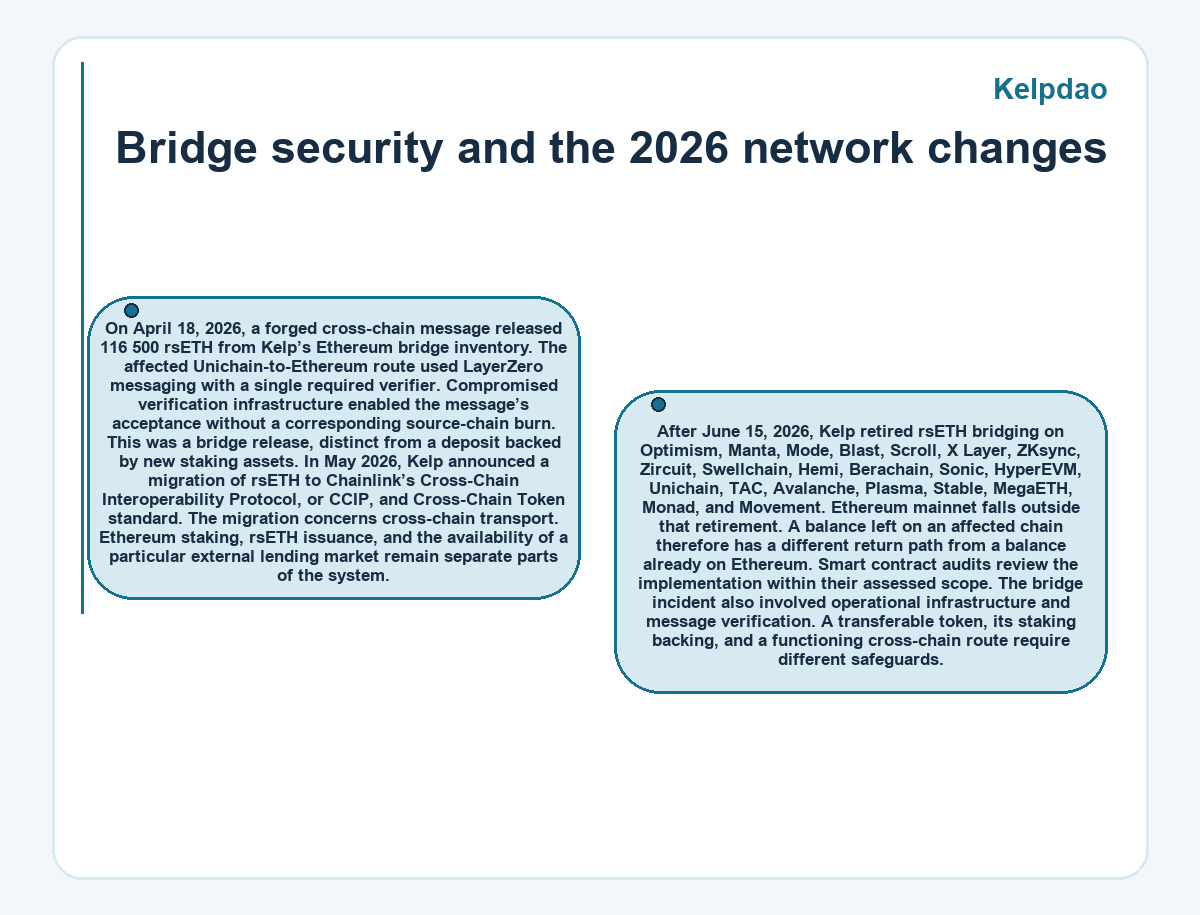
Can rsETH left on a retired network still be recovered?
The sunset program supports recovery of eligible balances held on affected networks at the June 15, 2026 cutoff, through June 15, 2027. It covers balances in self-custodied wallets. Assets deposited in an external lending market or liquidity pool must return to the holder’s wallet first. The sunset recovery fee is 100 USDC per address, payable on Ethereum mainnet. This separate payment does not reduce the equivalent rsETH payout.
For Ethereum Virtual Machine (EVM) networks, recovery requires conversion from wrsETH where applicable, a permanent burn of rsETH on the source network, and submission of the burn and fee transactions through Kelp’s dedicated claims channel. Burning wrsETH or another token cannot recover that asset. Verified claims settle quarterly as equivalent rsETH on Ethereum, sent to the same EVM address used for the burn and fee payment.
Movement uses a recovery Safe and its own ownership verification because it is not an EVM network. Its process returns rsETH to the declared Ethereum payout address, which must also send the mainnet recovery fee. The EVM burn procedure does not apply to Movement.
Token forms and the wider KernelDAO ecosystem
Kelp’s rsETH token, Gain’s vaults, and the separate Kernel restaking product have distinct roles within KernelDAO.
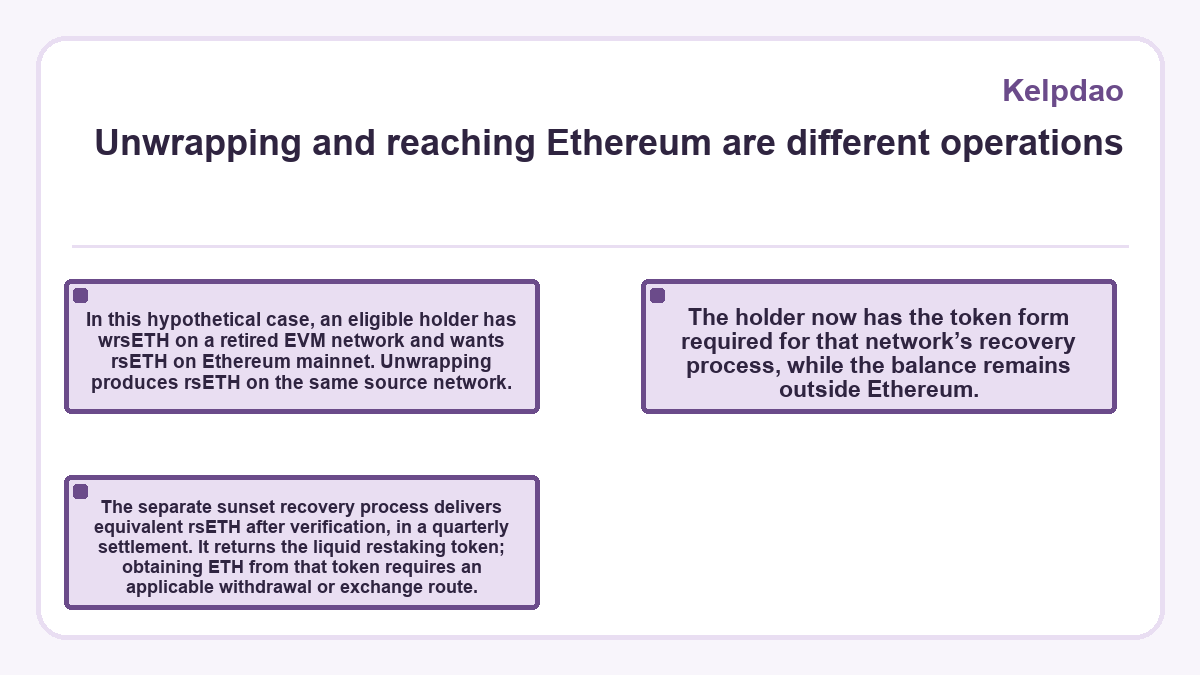
Unwrapping and reaching Ethereum are different operations
In this hypothetical case, an eligible holder has wrsETH on a retired EVM network and wants rsETH on Ethereum mainnet. Unwrapping produces rsETH on the same source network. The holder now has the token form required for that network’s recovery process, while the balance remains outside Ethereum.
The separate sunset recovery process delivers equivalent rsETH after verification, in a quarterly settlement. It returns the liquid restaking token; obtaining ETH from that token requires an applicable withdrawal or exchange route.
Gain vaults and Kelp restaking
Gain is the ecosystem’s vault product for ETH and liquid assets. Its vault strategies have their own arrangements and fees. Holding rsETH represents a Kelp restaking position; it does not itself place that balance into a Gain vault.
Kernel’s separate wind-down
Kernel’s BNB restaking product entered wind-down in March 2026. The June 2026 retirement notice concerned that product and excluded Kelp and Gain. The shared ecosystem name does not give these products identical operating rules.
Holding a supported liquid staking token retains its staking exposure; rsETH also adds Kelp’s restaking arrangements and their associated dependencies.
Kelpdao: the short answers
Is KERNEL the token I receive when I restake ETH?
Kelp issues rsETH for its liquid restaking deposits. KERNEL is the wider KernelDAO ecosystem’s governance token, covering Kelp, Gain, and the Kernel product. These tokens serve different roles, so a KERNEL balance does not represent the same claim on underlying staking assets as rsETH.
Do I need ETH in addition to the liquid staking tokens I deposit?
Ethereum mainnet transactions require ETH for gas, including deposits made with a liquid staking token. Holding stETH or ETHx does not by itself pay that fee. Gas costs depend on execution and network conditions.
Does every DeFi position qualify for programmatic EIGEN rewards?
A DeFi position must fall within the program’s eligible Kelp-supported positions of rsETH or agETH to receive programmatic EIGEN rewards. The program allocates rewards using each week’s contribution. A protocol’s ability to handle rsETH establishes token compatibility; the reward program’s rules separately determine whether it counts that position for an allocation.
Can Kelp recover rsETH if I lose access to my wallet keys?
Sunset recovery requires transactions from the wallet holding the eligible rsETH. Kelp cannot recover on a holder’s behalf when lost private keys or a lost recovery phrase prevent access to that wallet. The program returns controlled balances to Ethereum; it does not restore missing wallet credentials.
Why does Movement recovery require a MOVE transfer?
The MOVE transfer proves control of the Movement address requesting recovery. Kelp provides a one-time exact-amount challenge with a 30-day expiry through the existing claims conversation. The holder must send that amount from the same Movement address to the recovery Safe, then submit its transaction hash in that conversation. This ownership check is specific to the Movement process.
Is an unsolicited message from an rsETH recovery agent legitimate?
Kelp never initiates sunset recovery through unsolicited direct messages or asks for a seed phrase or private key. Recovery uses its dedicated claims channel. A message demanding wallet secrets contradicts that process.