 Kelpdao
Kelpdao issues rsETH as the transferable token for its Ethereum restaking positions
Kelpdao manages Ethereum liquid restaking, while rsETH represents the position its holders can transfer to compatible applications. The protocol accepts ETH and supported liquid staking tokens, coordinates restaking through EigenLayer, and accounts for the backing. rsETH is the receipt held in a wallet or used in decentralized finance (DeFi). Its balance differs from the assets the protocol manages. Network, token form, and integration rules determine how that receipt can function outside the underlying restaking pool.
Updated on
The protocol’s rsETH exchange rate describes its pooled backing, while a trading venue determines the executable price.
Kelpdao and EigenLayer connect the backing to restaking services
Deposited assets provide the backing, Kelpdao coordinates the pooled position, and EigenLayer supplies the restaking layer. Restaking puts staked capital to work securing additional services. The receipt connects ownership of the position to those underlying assets. Moving rsETH between holders does not itself withdraw assets from the underlying staking or restaking arrangements.
The deposit pool receives supported assets. Node Delegator contracts allocate assets into EigenLayer strategies, while the LRT Oracle handles asset valuation and the rsETH exchange rate. Capital can occupy different places within this system, including deposits, delegated positions, and assets undergoing withdrawal. Accounting combines the relevant holdings in ETH terms. The token represents participation in that managed pool, whose composition and service exposure can change.
rsETH carries ownership of the pooled position
rsETH is a fungible ERC-20 receipt for the protocol’s pooled Ethereum restaking position. Fungibility means units of the same token contract follow the same accounting, regardless of their holder’s original deposit asset. A wallet displays token quantity and ownership; it does not contain the underlying validator deposits. The ERC-20 interface lets compatible applications handle balances and transfers through standard token operations. Compatibility still requires the application to accept the correct token contract on the correct network. A familiar ticker cannot establish that acceptance, and receiving the receipt does not place its backing under the holder’s direct operational control.
Why can an rsETH balance stay unchanged while its value changes?
rsETH uses exchange-rate accounting, so rewards incorporated into its backing need not arrive as additional wallet tokens. Token quantity and accounted ETH value are separate measurements.
The protocol values its supported assets in ETH and calculates an exchange rate relative to rsETH supply. Staking returns and restaking activity affect the assets the pool accounts for, while applicable protocol charges affect the value holders retain. Reward growth can raise the value each token represents. A backing loss or accounting adjustment can move that value downward. The rate therefore describes the pooled position rather than promising a permanently increasing value or a fixed one-token-to-one-ETH relationship.
A market quote answers a different question: what a trade can deliver under the venue’s execution conditions. Available liquidity, fees, and price impact influence that quote. The protocol rate alone cannot establish the amount obtainable through an immediate sale.
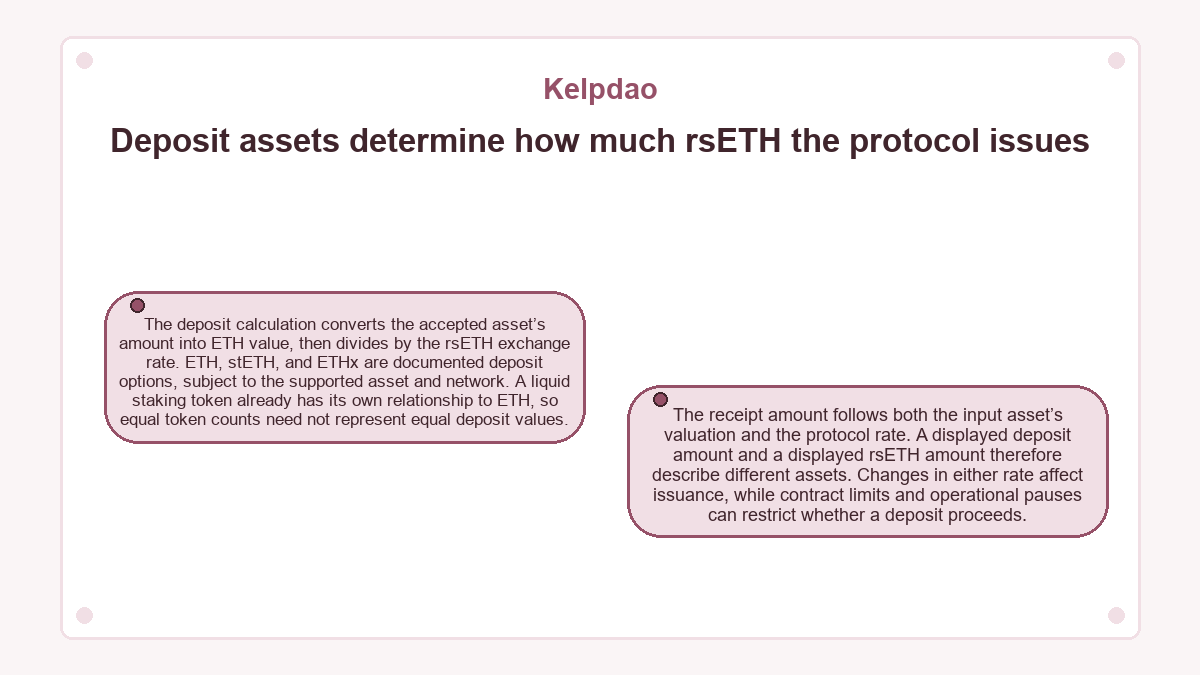
Deposit assets determine how much rsETH the protocol issues
The deposit calculation converts the accepted asset’s amount into ETH value, then divides by the rsETH exchange rate. ETH, stETH, and ETHx are documented deposit options, subject to the supported asset and network. A liquid staking token already has its own relationship to ETH, so equal token counts need not represent equal deposit values. The receipt amount follows both the input asset’s valuation and the protocol rate. A displayed deposit amount and a displayed rsETH amount therefore describe different assets. Changes in either rate affect issuance, while contract limits and operational pauses can restrict whether a deposit proceeds.
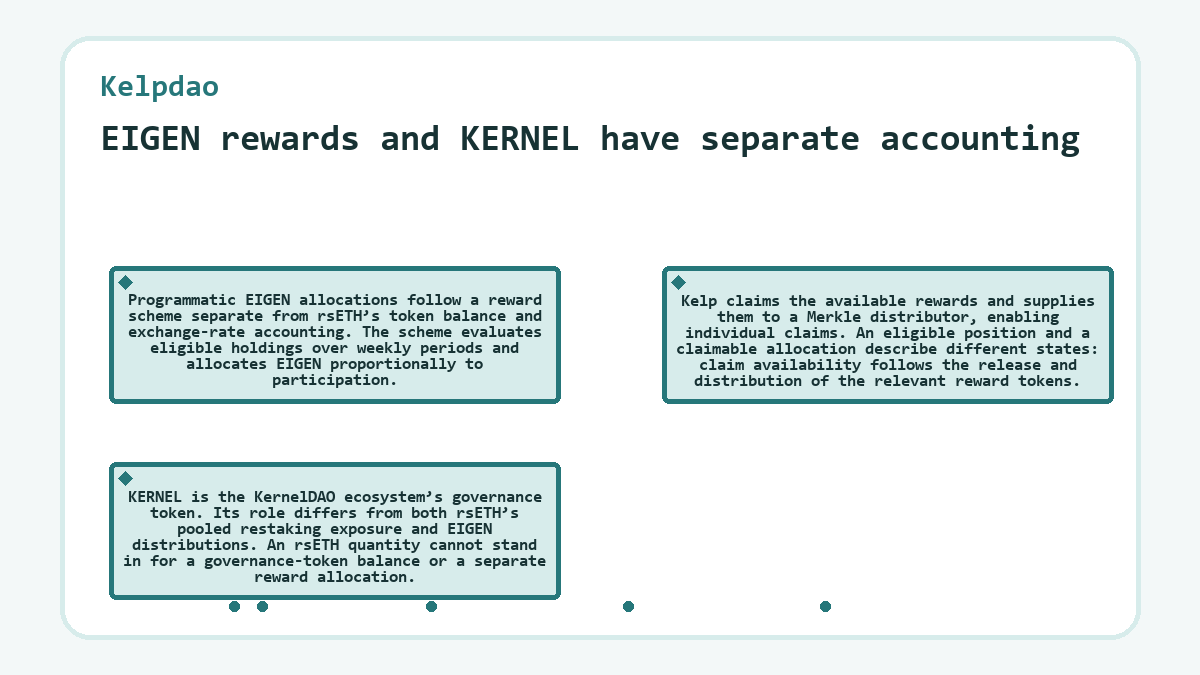
EIGEN rewards and KERNEL have separate accounting
Programmatic EIGEN allocations follow a reward scheme separate from rsETH’s token balance and exchange-rate accounting. The scheme evaluates eligible holdings over weekly periods and allocates EIGEN proportionally to participation. Kelp claims the available rewards and supplies them to a Merkle distributor, enabling individual claims. An eligible position and a claimable allocation describe different states: claim availability follows the release and distribution of the relevant reward tokens.
KERNEL is the KernelDAO ecosystem’s governance token. Its role differs from both rsETH’s pooled restaking exposure and EIGEN distributions. An rsETH quantity cannot stand in for a governance-token balance or a separate reward allocation.
DeFi acceptance adds conditions beyond token ownership
A compatible DeFi integration can use rsETH for trading or lending without taking over management of its underlying restaking pool. The token supplies the exposure; the integration adds its own contract rules. In a borrowing arrangement, collateral valuation and liquidation conditions govern the resulting position. Lending-market liquidity also affects withdrawal access independently of the value the token represents.
Aave froze rsETH and wrsETH reserves during its April 2026 response to the bridge incident. The freezes disabled new supply and borrowing. Existing positions remained eligible for repayment and liquidation. Those measures governed lending-market operations following a failure in third-party bridge infrastructure.
Ongoing use requires the particular market to support the token and requested operation. An integration’s past listing cannot establish present deposit access. Additional exposure comes from the venue’s contracts and market parameters, while the position retains its dependence on Kelp’s backing and restaking arrangements.
Choosing the right interpretation of an rsETH holding
An rsETH holder can keep the token in a wallet while Kelp manages its backing. If the holder instead uses rsETH as collateral for a loan in a compatible market, access to that collateral also depends on the debt and the market’s withdrawal rules. Lending adds collateral requirements, and wrapped or bridged holdings add token-form and network constraints. Apply the conditions relevant to the holding:
- If the entry is rsETH in a wallet, distinguish its token quantity from the protocol’s ETH exchange rate.
- If the entry is a swap quote, assess the offered output together with that trade’s fees and execution conditions.
- If rsETH supports a borrowing position, apply that market’s collateral and liquidation rules.
- If the entry is wrsETH, identify the wrapper before treating its amount as directly usable rsETH.
- If the balance sits on a retired network, token ownership no longer implies normal bridge availability.
Ethereum rsETH and bridged rsETH rely on different backing paths
Ethereum mainnet rsETH draws on the protocol’s underlying staking deposits, while remote representations add bridge infrastructure. Under the LayerZero lock-and-mint arrangement involved in the April 2026 incident, an Ethereum adapter held rsETH backing remote copies. Cross-chain verification had to preserve the relationship between that locked balance and the remote supply. Wrapping changes a token’s form on a network; it does not itself transfer the position to Ethereum.
The April 18, 2026 bridge attack released 116 500 rsETH from the Ethereum bridge adapter. The affected Unichain-to-Ethereum route required a single verifier and accepted a forged message without a corresponding source-side burn. The failure concerned the bridge’s locked rsETH, distinct from the underlying mainnet restaking deposits. It exposed a dependency attached to the remote representation beyond the receipt’s basic ERC-20 interface.
After June 15, 2026, Kelp retired rsETH bridging on selected networks, including Optimism, Scroll, Unichain, and Movement. Eligible balances left on those networks use sunset-recovery arrangements available through June 15, 2027. Recovery applies the June 15 cutoff and requires access to the holding wallet. Tokens in third-party DeFi positions must first return to that wallet. Ethereum mainnet remained outside that network-retirement list; a token name alone cannot identify the operations available on another chain.
Kelpdao and rsETH: Protocol versus token
- DeFi acceptance adds conditions beyond token ownership
- Choosing the right interpretation of an rsETH holding
- Ethereum rsETH and bridged rsETH rely on different backing paths
- Contract controls and product changes qualify token utility
Contract controls and product changes qualify token utility
rsETH’s contract controls and Kernel’s separate wind-down affect different parts of the ecosystem. Privileged controls in the Ethereum rsETH contract design can restrict transfers involving selected addresses. Kernel entered wind-down in March 2026, and its June interface-retirement update concerned the BNB restaking product. That change left Kelp’s rsETH product and Gain vaults outside its scope. A shared ecosystem name does not extend Kernel’s BNB claim mechanism to an rsETH balance.
What to know about Kelpdao
Can I acquire rsETH without making a new restaking deposit?
A transfer or supported market purchase can put existing rsETH in your wallet without minting new tokens. A secondary-market purchase moves an existing receipt between holders; it does not itself add ETH to Kelpdao’s deposit pool. The underlying protocol exposure remains, and trading costs and execution conditions belong to the selected market.
Does holding rsETH let me choose an EigenLayer operator?
Holding rsETH does not give its owner direct control over the pool’s EigenLayer delegation. Protocol managers direct delegation through Node Delegator contracts, and the receipt represents the exposure those allocations create. Transferring rsETH changes token ownership without itself changing the pool’s delegation instructions or giving the recipient management of the underlying assets.
What does the 2% buffer in EIGEN allocations represent?
The programmatic EIGEN scheme temporarily sets aside 2% of allocated tokens as a buffer. Its rules provide for proportional redistribution of the unused portion every four to five weeks. This adjustment concerns the EIGEN allocation, rather than an rsETH transfer fee or redemption charge. The buffer does not change the number of rsETH tokens in a wallet.
Do incoming rsETH transfers authorize a DeFi application to spend my tokens?
An incoming rsETH transfer does not itself create a spending allowance for a DeFi application. ERC-20 allowances concern a particular token owner and spender, and any existing allowance remains a separate permission. Approval grants spending authority within its specified amount; it does not by itself establish a completed lending deposit or other DeFi position.
Why does Ethereum rsETH use 18 decimal places?
Ethereum rsETH inherits an ERC-20 implementation whose default display precision is 18 decimal places. One whole rsETH corresponds to 10^18 base units, allowing quantities smaller than a whole token. Precision describes the token’s accounting units. It does not establish an ETH conversion rate, a market price, or a reward percentage; those measurements arise from different parts of the position.
Is a restaking deposit minimum also a minimum for transferring existing rsETH?
The documented deposit-pool contract rejects deposits below its configured minimum. That minimum does not establish a minimum transfer size for existing rsETH. Transfers follow the token contract’s conditions, while an exchange can impose separate limits. A threshold displayed in a restaking interface therefore applies to its specified operation, rather than automatically extending to every use of the receipt.